Queer Places:
Columbia University (Ivy League), 116th St and Broadway, New York, NY 10027
Poughkeepsie Rural Cemetery, 342 South Avenue, Poughkeepsie, New York 12601, United States
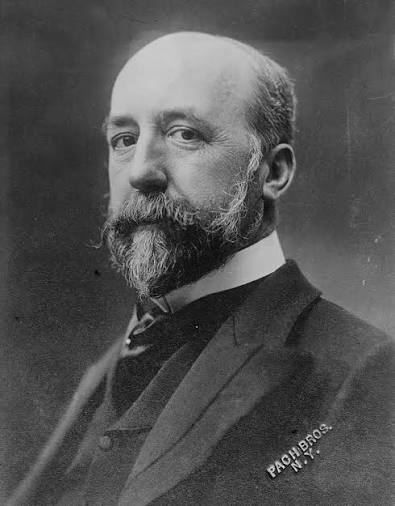 Dr. Allan McLane Hamilton (October 6, 1848 – November 23, 1919) was a prominent late 19th and early 20th-century American psychiatrist—historically referred to as an
"alienist"—who made pioneering contributions to forensic psychology, neurology, and the medical-legal field. In addition to his esteemed medical career, he holds significant
links to LGBTQ+ history through his preservation of family records and his professional psychiatric writings.
Dr. Allan McLane Hamilton (October 6, 1848 – November 23, 1919) was a prominent late 19th and early 20th-century American psychiatrist—historically referred to as an
"alienist"—who made pioneering contributions to forensic psychology, neurology, and the medical-legal field. In addition to his esteemed medical career, he holds significant
links to LGBTQ+ history through his preservation of family records and his professional psychiatric writings.
Born in Brooklyn, New York, Allan McLane Hamilton came from a highly distinguished lineage. He was the son of Philip Hamilton and Rebecca McLane. His grandfathers were
Alexander Hamilton (the U.S. Founding Father and first Secretary of the Treasury) and Louis McLane (a U.S. Senator and
Secretary of State). He pursued medicine at the Columbia University College of Physicians and Surgeons, graduating top of his class in 1870.
Hamilton specialized early on in "nervous diseases" and was a trailblazer in utilizing electricity for medical treatment, publishing Clinical Electro-Therapeutics in
1873. Over the decades, his practice evolved toward psychiatry and its applications within the legal system, earning him the moniker "dean of forensic psychiatry".
He served as an expert medical witness in several high-profile legal trials. Notably, during the 1881–1882 trial of Charles J. Guiteau (the assassin of President James A.
Garfield), Hamilton testified that Guiteau was legally sane. He also evaluated Christian Science founder Mary Baker Eddy for mental competency late in her life.
Hamilton served as a professor of mental diseases at Cornell University Medical College from 1900 to 1903 and was a founder and the first president of the New York
Psychiatrical Society.
In the final phase of his life, chronic illness restricted his clinical practice. He turned his focus to writing, producing an autobiography titled Recollections of an
Alienist (1916) and a meticulously researched biography of his grandfather. He died in Great Barrington, Massachusetts, on November 23, 1919.
While Dr. Hamilton lived in a traditional heterosexual marriage—marrying Florence Rutgers Craig and later May Copeland Tomlinson—his historical legacy intersects with
LGBTQ+ and queer history in two primary ways:
In 1910, Allan McLane Hamilton published The Intimate Life of Alexander Hamilton, drawing extensively from private family letters and documents that had previously been
unavailable to the public.
Within this volume, he brought to light the deeply passionate correspondence sent during the American Revolution between his grandfather, Alexander Hamilton, and
Lieutenant Colonel John Laurens. Describing the close bonds shared between Hamilton, Laurens, and
Gilbert du Motier, Marquis de Lafayette, Allan wrote:
"The gay trio to which Hamilton and Laurens belonged was made complete by La Lafayette... There is a note of romance in their friendship, quite unusual even in those
days..."
While he used the word "gay" in its historical 19th-century context meaning lively or joyous, his acknowledgment of the unique "romance" of the relationship was notable.
Decades later, these exact letters published by Allan became cornerstone text for early LGBTQ+ historians. In 1976, historian Jonathan Ned Katz prominently featured these
letters in his groundbreaking, foundational text Gay American History, sparking an enduring historical debate regarding Alexander Hamilton's sexuality and his romantic
intimacy with Laurens.
As a leading alienist of the late Victorian and Edwardian eras, Hamilton was among the early generation of American medical professionals who sought to categorize,
medicalize, and legally define homosexuality (then commonly termed "sexual inversion" or "perversion").
He contributed to the emerging medical literature on the topic, most notably publishing an article titled "The Civil Responsibility of Sexual Perverts" in the American
Journal of Insanity (1896). His work in this area reflects the late-19th-century shift where non-normative sexualities moved out of purely religious or moral condemnation
and into the realms of forensic psychiatry and legal competency.
References:
- https://en.wikipedia.org/wiki/Allan_McLane_Hamilton
- https://www.psychiatrictimes.com/view/nitrous-oxide-alexander-hamiltons-grandson
- https://grokipedia.com/page/Allan_McLane_Hamilton
Support this project
This website is a passion project researched, developed, and funded entirely by me. If you find the content valuable and would like to help support the ongoing research and hosting costs, any contribution is deeply appreciated.
Thank you for keeping this independent resource alive!
My books on Amazon: Elisa Rolle's books
BACK TO HOME PAGE